

Surface and Use-wear Research of Tools (SUTR lab.)

The laboratory focuses on the study of artefact technology and function through use-wear analysis. It builds on a long-standing tradition of comprehensive research on stone artefacts, dating back to the publication in Památky archeologické on stone tools from the Neolithic site of Bylany near Kutná Hora (Pavlů and Rulf et al. 1991).
Since 2022, the laboratory’s research has concentrated primarily on so-called macroliths—artefacts shaped by coarse and fine battering, pecking, and grinding (and occasionally drilling). These tools were used to process a wide range of materials through crushing, grinding, rubbing, and pounding, and possibly also cutting (e.g. axes and adzes).
A key component of the laboratory is its experimental collection of macrolithic replicas made from sedimentary, metamorphic, and volcanic raw materials (e.g. sandstone, rhyolite, mudstone). This work has resulted in a comprehensive comparative use-wear reference collection focused on the processing of various plant materials (e.g. wheat, barley, acorns, broad beans, millet). The collection serves as an essential reference for the functional interpretation of prehistoric tools.
The reference collection was developed with the active involvement of secondary school students participating in experiments as part of the Open Science internship programme of the Academy of Sciences of the Czech Republic.
The laboratory is equipped with an Olympus SZX7 stereomicroscope, an Olympus BXFM optical microscope with a Canon EOS 1200D camera, and a newly developed LEXT OLS5100 3D laser scanning microscope.
Geographically, the laboratory’s research focuses primarily on Central Europe, Southwest Asia, and Northeast Africa.
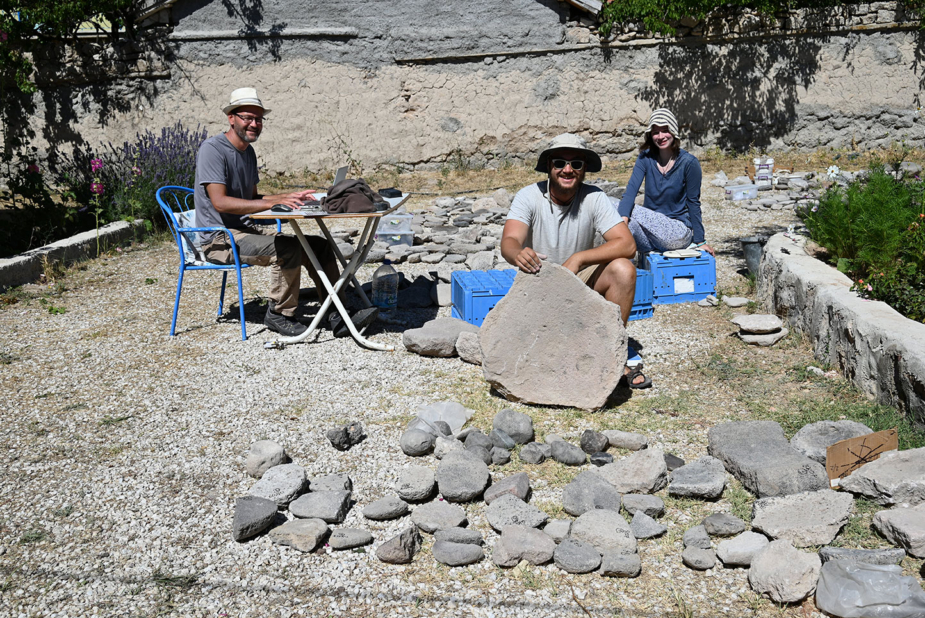
Laboratory members
Mgr. Kristina Doležalová (head of laboratory, use-wear analyses, stone material analysis, experiments)
Mgr. Daniel Pilař (3D documentation, statistical analysis, experiments)
Mgr. Jaroslav Řídký, Ph.D. (contacts, morphometric analysis, comparative analysis)
Permanent laboratory collaborators
Carlos G. Santiago-Marrero, Ph.D. (archaeobotanist – microresidual analysis)
Andrea Zupancich, Ph.D. (use-wear and residue analysis of prehistoric stone tools)
doc. Mgr. Aleš Bajer, Ph.D. (geologist)
Mgr. Robert Trnka (experimenter, use-wear analyses)
Barbora Šídová (experimenter)
Contact: ridky@arup.cas.cz
Bibliography:
Řídký, J. – Půlpán, M. – Šreinová, B. – Šrein, V. – Drnovský, V. – Květina, P. 2014: „Životní cyklus“ mlecích nástrojů z mladoneolitického sídelního areálu s rondelem ve Vchynicích, okr. Litoměřice. “Life cycle” of grinding tools from the Late Neolithic settlement area with rondel at Vchynice, Northwest Bohemia. Archeologické rozhledy, LXVI(2), 271–309.
Řídký, J. – Končelová, M. – Burgert, P. – Šumberová, R. – Hadacz, R. 2020: Grinding tools and circular enclosures: Activities on late Neolithic settlements. In P. Bye‑Jensen & M. Bjørnevad‑Ahlqvist (Eds.), The Life Biography of Artefacts and Ritual Practice (pp. 23–34). Oxford: BAR Publishing (BAR S2991).
Řídký, J. – Stadler, P. 2021: Macrolithic artefacts from Brunn am Gebirge, Wolfholz. In: P. Stadler – N. S. Kotova (eds.), Early Neolithic Settlement Brunn am Gebirge, Wolfholz, Site 3 in Lower Austria and the Milanovce Phase of the Linear Pottery Culture (LPC). Early Neolithic Settlement Brunn am Gebirge, Wolfholz, in Lower Austria, Volume 2. Lagenweissbach: Beier & Beran, 267–289.
Řídký, J. – Varadzin, L. – Varadzinová, L. 2022: An Introduction to the Study of (Late) Prehistoric Ground Stone Artefacts in the Western Part of Jebel Sabaloka in Central Sudan / Úvod do studia pravěkých broušených kamenných artefaktů ze západní části pohoří Sabaloka ve středním Súdánu. Památky archeologické 113, 1, 5–44. doi: 10.35686/PA2022.1.
Doležalová, K. – Řídký, J. – Pilař, D. 2023: Rhyolite Grinding-Milling Tools in Focus: Assessing Kinematics with the Help of Use-Wear Analysis. Archeologické rozhledy 75, 2, 109–131. doi: 10.35686/AR.2023.9.
Řídký, J. – Caneva, I. – Doležalová, K. – Pilař, D. 2024: Macro-lithic Artefacts from Chalcolithic Levels at Yumuktepe-Mersin Site. In: I. Caneva ed., The Chalcolithic and Early Bronze Age Sequence at Yumuktepe, İstanbul: Ege Yayınları, 193–216.
Řídký, J. – Doležalová, K. – Pilař, D. – Çaylı, P. – Demirtaş, I. – Gülçur, S. 2025: Behind the wall: Macrolithic artifacts as testing tools for activities and social structure on a Middle Chalcolithic site in Central Anatolia. PLOS ONE, Edited by C. P. Odriozola 20, 4, e0319698. doi: 10.1371/journal.pone.0319698.
Řídký, J. – Zavřel, J. – Varadzinová, L. – Burgert, P. – Unger, J. – Varadzin, L. 2025: First Conclusions on Early-Middle Holocene Ground (Sand)Stone Production in the Eastern Sahel: View from the Shaqadud Site Complex (North-West Butana, Sudan). Journal of Archaeological Science: Reports 62, 104991. doi: 10.1016/j.jasrep.2025.104991.
Doležalová, K. – Kaner, T. – Bobik, J. – Pavúk, P. – Luke, C. – Roosevelt, C. H. 2025: A tale of volcanic rocks: Life histories of grinding stones from Bronze Age Kaymakçı. Journal of Archaeological Science: Reports 62, 104996. doi: 10.1016/j.jasrep.2025.104996.
Řídký, J. – Pilař, D. – Doležalová, K. – Bajer, A. – Çakan, Y. G. 2026: Shifting Foodways in Central Anatolia: A Millenium of Macrolithic Artefacts at Tepecik-Çiftlik (6800/6700–5800/5700 cal BCE). Journal of Archaeological Science: Reports 70, 105575. doi: 10.1016/j.jasrep.2026.105575.